
1207-1273
Rumi
Persian / Anatolian · Sufi Muslim · High medieval
One of the archetypal poets of divine longing; the later Mevlevi tradition joins his poetic world with music and whirling.
PoetryLoveMusicMovement
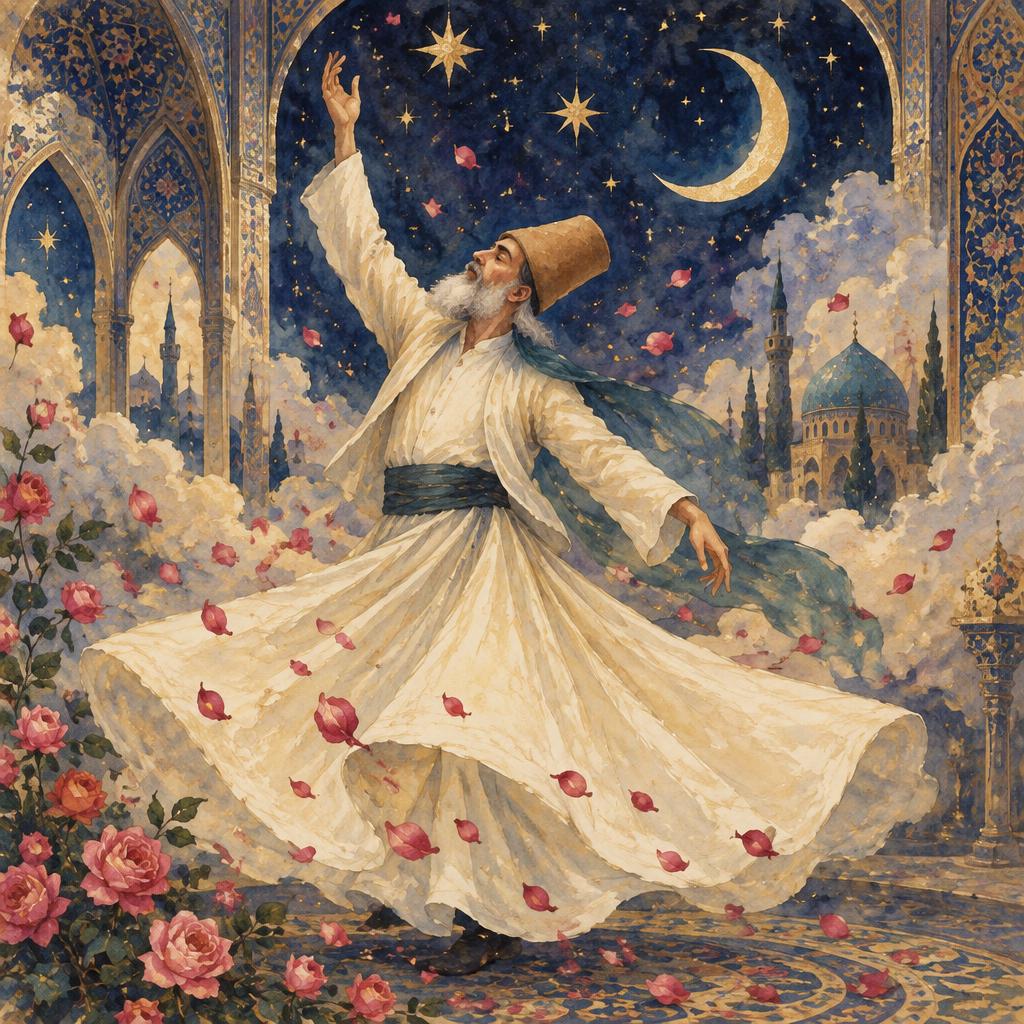
The poet who turned longing into a doorway
Jalāl al-Dīn Muḥammad Rūmī was born in 1207 in Balkh, in what is now Afghanistan, and died in Konya, Turkey, in 1273. Today he is the best-selling poet in the United States, yet his popularity is not a modern accident. Rumi speaks a language the soul already knows: the language of longing, surrender, and the terrible sweetness of separation from the Beloved.
"The wound is the place where the Light enters you."
He was a respected scholar, jurist, and theologian until 1244, when he met a wandering dervish named Shams of Tabriz. That meeting shattered the polite world of his learning and ignited a fire that produced thousands of poems, the *Mathnawi* — a six-volume masterpiece of Sufi teaching — and the ecstatic practice of the *sama*, the whirling prayer that still turns in Konya every December.
Why Rumi matters for the sacred arts
Rumi is not only a poet. He is a map of how form becomes a vehicle for consciousness. The verse, the breath, the turn, the drum, the rose: in his hands each becomes a ladder from the visible world into the invisible one.
For Boston Mystics, Rumi is a primary doorway because his work joins intellect and ecstasy. You can study his lines in a circle of friends, sing them in a *raga*-infused melody, or let them carry you into spontaneous movement. The text does not stay on the page. It becomes breath, then body, then prayer.
"Dance, when you are broken open. Dance, if you have torn the bandage off. Dance in the middle of the fighting. Dance in your blood. Dance, when you are perfectly free."
The Mathnawi and the Divan of Shams
The *Mathnawi* weaves scripture, folklore, animal fables, and erotic longing into a continuous teaching on the soul’s return to its Source. The *Divan-i Shams*, written after Shams disappeared, is wilder — shorter poems in many meters, sometimes tender, sometimes ferocious, always drunk with love.
Reading Rumi is not an intellectual exercise. It is an invitation. The poems ask you to stop performing spirituality and actually fall in love with what is real.
Whirling as a technology of consciousness
The Mevlevi *sama* is often called "whirling." It is a disciplined ritual of abandonment: one palm turned upward to receive grace, one palm turned downward to give it, the body spinning like a planet around the heart. The dancer removes the ego from the center and places truth there instead.
At Boston Mystics, whirling is not entertainment. It is one of the technologies of consciousness we explore — alongside breath, voice, touch, poetry, and ceremony — to remember that the body can become an instrument for what moves through it.
Experience Rumi in Boston
Luba Evans brings Rumi’s spirit into live gatherings through poetry, music, movement, and the *sama*. If you are drawn to divine love, sacred poetry, or the turning prayer, join a Boston Mystics evening and let Rumi’s verses become something you do with your whole body.
Nearby in the constellation
Mirabai
Rajasthani Indian · Krishna Bhakti
Divine love is experienced as intensely personal longing; singing becomes devotional technology.
ReadHildegard of Bingen
German · Christian
A visionary whose mystical consciousness generated music, text and images rather than separating those media.
ReadIbn Arabi
Andalusian / Arab · Sufi Muslim
Important for the imaginal: spiritual realities can appear through forms that mediate between material perception and abstraction.
Read