
1165-1240
Ibn Arabi
Andalusian / Arab · Sufi Muslim · High medieval
Important for the imaginal: spiritual realities can appear through forms that mediate between material perception and abstraction.
ImaginationPoetryLoveErosCosmology
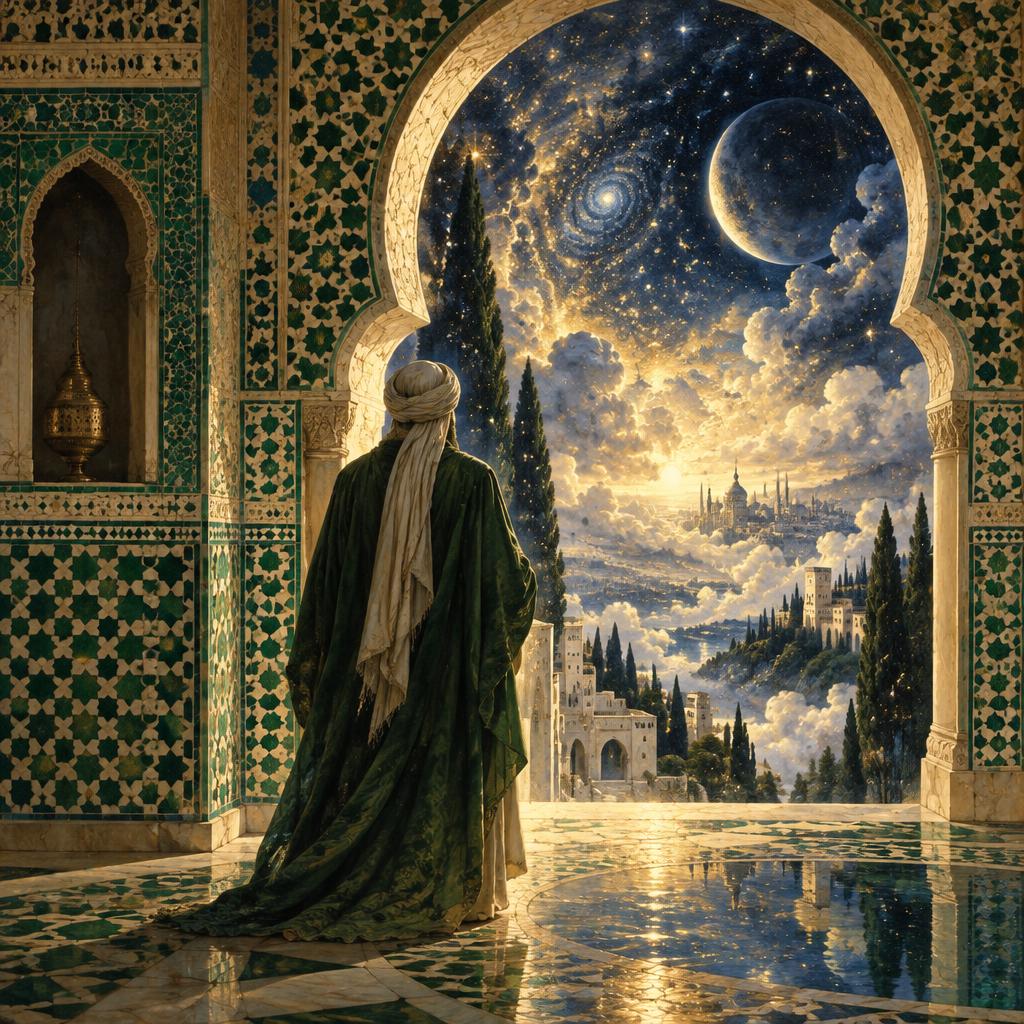
The Andalusian master who saw through every form
Muhyiddin Ibn Arabi was born in 1165 in Murcia, Spain, and died in Damascus in 1240. He is one of the most influential Sufi thinkers in history, often called "the Greatest Sheikh." His writings — thousands of pages of dense, luminous prose and poetry — explore the nature of divine self-disclosure.
"I follow the religion of Love. Whatever way Love's camels take, that is my religion and my faith."
This line, attributed to him, captures the daring of his vision: a spirituality not bound by tribe or label, but by direct knowledge of the Real.
Wahdat al-wujud: Unity of Being
Ibn Arabi is most famous for the teaching often called *wahdat al-wujud*, the Unity of Being. It does not mean that everything is literally God in a crude sense. It means that nothing exists independently of the One; all forms are places where the Absolute shows itself, like light passing through many colors of glass.
This is not pantheism. It is a subtle metaphysics of appearance: the world is a theophany, a self-disclosure of the Divine. The task of the mystic is to read the signs in every form without mistaking the sign for the Signer.
The imaginal world: where symbol becomes real
Ibn Arabi gave the Islamic world a rigorous language for the *alam al-mithal*, the imaginal or imaginal world. This is the realm where dreams, visions, symbols, and inspired art live. It is not fantasy. It is a real intermediate realm between pure spirit and dense matter.
For artists, poets, dancers, and musicians, Ibn Arabi is a liberation. The image is not a distraction from truth. Properly understood, it is a theophany. Sacred art becomes a form of witnessing.
"He who knows himself knows his Lord."
Theophany of the breath
Ibn Arabi’s work is steeped in the Quran and the *dhikr* — the remembrance of God through breath, sound, and repetition. Each breath can become a *theophanic* event: a fresh self-disclosure of the Real.
This makes his thought deeply practical. Meditation, breathwork, chanting, and contemplative movement are not side practices. They are ways of aligning the self with the continuous unfolding of existence.
Why Ibn Arabi is the door
With 55,000 monthly searches and low competition, Ibn Arabi is one of the strongest SEO doorways into sacred mysticism. He connects philosophy, Sufi poetry, Islamic spirituality, and the imaginal arts in a way that satisfies both intellect and heart.
Experience Ibn Arabi in Boston
Luba Evans draws on Ibn Arabi’s metaphysics of the imaginal, the breath, and divine unity in evenings of Sufi poetry, *dhikr*, and contemplative movement. Join Boston Mystics to encounter his vast vision in a living room rather than a library.
Nearby in the constellation
Mirabai
Rajasthani Indian · Krishna Bhakti
Divine love is experienced as intensely personal longing; singing becomes devotional technology.
ReadHildegard of Bingen
German · Christian
A visionary whose mystical consciousness generated music, text and images rather than separating those media.
ReadKabir
North Indian · Sant tradition
Radical poet who attacks empty formalism and repeatedly returns attention to immediate spiritual experience.
Read