
15th c.
Kabir
North Indian · Sant tradition · Living tradition
Radical poet who attacks empty formalism and repeatedly returns attention to immediate spiritual experience.
PoetrySongDirect experience
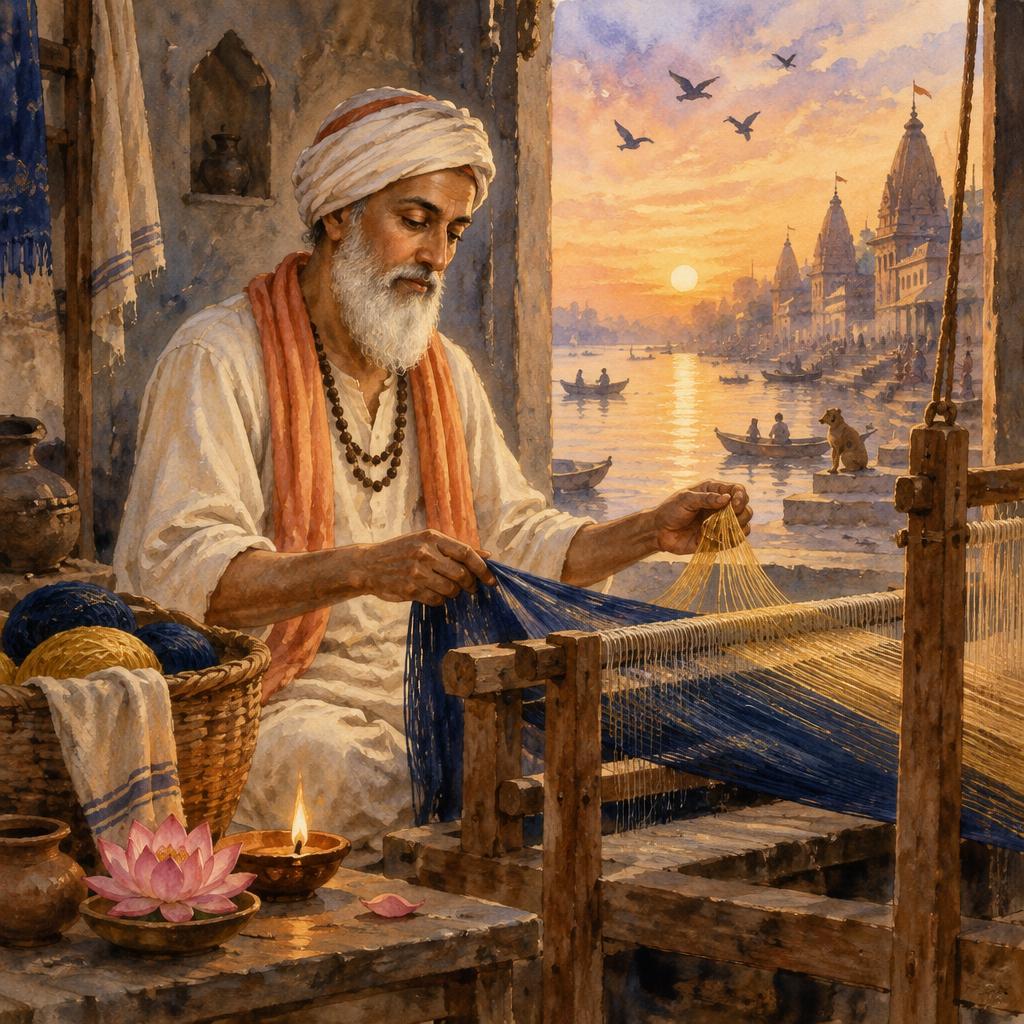
The weaver of Benares
Kabir was born around 1440, probably near Varanasi — the holy city of Benares — and lived as a low-caste Muslim weaver. He never founded an institution, yet his poems are sung across North India by Hindus, Muslims, Sikhs, and spiritual seekers of every background.
"Are you looking for me? I am in the next seat. My shoulder is against yours."
That directness is the core of Kabir. No pilgrimage, no priest, no holy book is necessary if the divine is already breathing inside you.
Songs of direct experience
Kabir wrote in the vernacular, using the simplest images: the loom, the thread, the shuttle, the dyer's vat, the river, the fish. His poems are short, sharp, and unforgettable. They cut through religious pride and social pretense.
"The river that flows in you also flows in me."
His teaching is *nirgun bhakti* — devotion to the formless One — expressed with the earthiness of a craftsman. You do not need to renounce the world. You need to see through it while staying in it.
Between mosque and temple
Kabir refused to be claimed by either Hindus or Muslims. He mocked the Brahmin for his ritual purity and the Mullah for his book-learning. Both, he said, missed the living God who is nearer than the jugular vein.
This makes Kabir a patron saint of interspirituality. He belongs nowhere and therefore everywhere. His songs are still sung at Sufi gatherings, Hindu temples, and secular poetry festivals around the world.
The thread and the name
Kabir's central practice is the repetition of the *naam*, the divine name, and the weaving of awareness into ordinary labor. The loom becomes an altar. The breath becomes a thread. Work and worship are not separate.
For modern people seeking a spirituality that fits real life — work, love, failure, laundry — Kabir is a refreshing guide.
Why Kabir still cuts through
Kabir matters because he does not flatter the seeker. He does not sell comfort. He points to the obvious and asks why we keep missing it. His poems are a shock of clarity.
Experience Kabir in Boston
Luba Evans brings Kabir into the room through song, simple *bhajan* chant, and spoken poetry that lands in the body. If you want a mysticism without fluff, join Boston Mystics for an evening with Kabir.
Nearby in the constellation
Mirabai
Rajasthani Indian · Krishna Bhakti
Divine love is experienced as intensely personal longing; singing becomes devotional technology.
ReadHildegard of Bingen
German · Christian
A visionary whose mystical consciousness generated music, text and images rather than separating those media.
ReadIbn Arabi
Andalusian / Arab · Sufi Muslim
Important for the imaginal: spiritual realities can appear through forms that mediate between material perception and abstraction.
Read