
c. 714–801 CE
Rabia Basri
Iraq / Basra · Sufism · 8th century CE
The saint of Basra who taught that love, not fear or hope, is the only true motive on the Sufi path.
sufismdivine lovebhaktinight prayerdirect experienceecstatic loveiraq
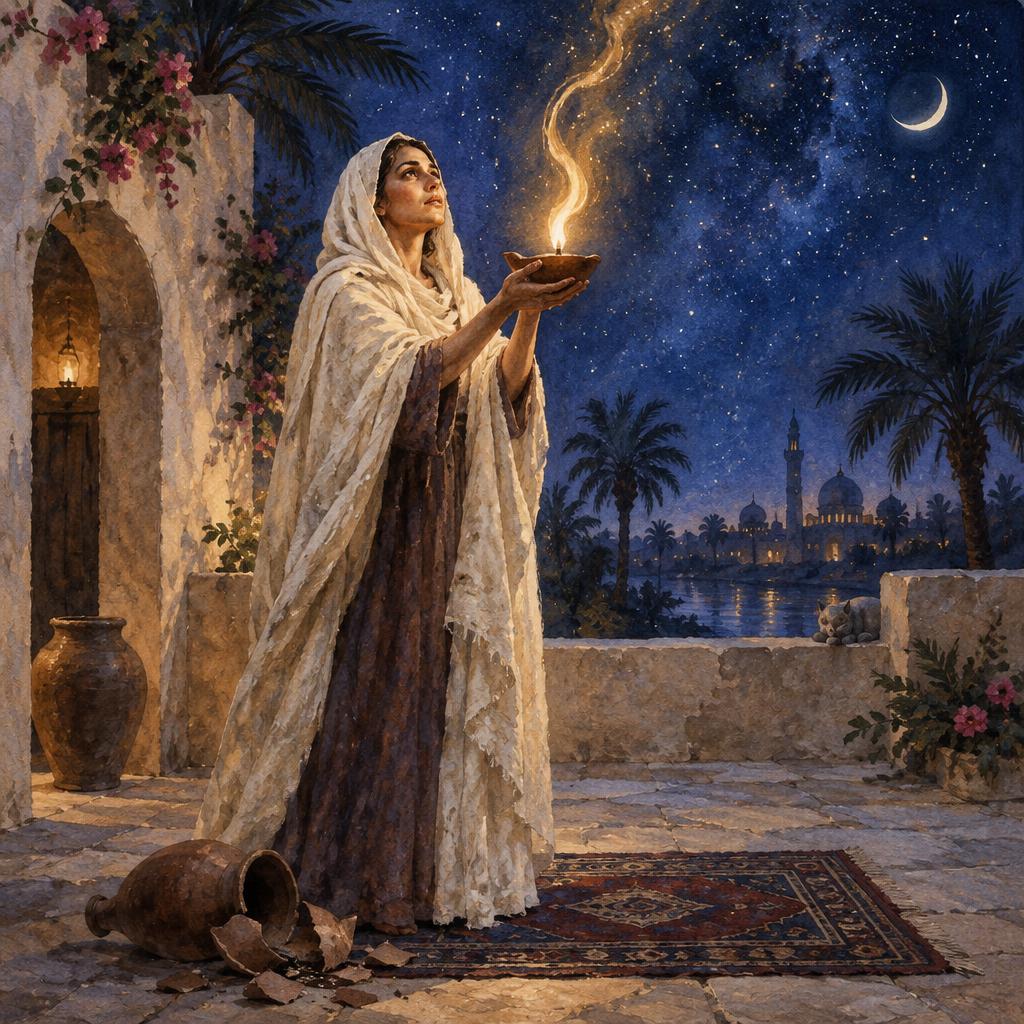
The saint of Basra
Rabia al-Adawiyya, known today as Rabia Basri, was born around 714 in Basra, in present-day Iraq. She was sold into slavery as a child, then freed, and became one of the most revered early Sufi saints. She lived in poverty, prayer, and an ecstatic love of God that became legendary.
"I have not served You from fear of Hell, for I should be like a wretched hireling. I have not served You from desire for Paradise, for I should be like a mercenary. I have served You only for the love of You."
This prayer — sometimes called the *Prayer of Rabia* — is one of the most revolutionary statements in spiritual history. She moved the motive of religion from reward and punishment to love alone.
Love before fear and hope
Before Rabia, Sufi practice was often framed in terms of repentance, fear of Hell, and hope for Paradise. Rabia reframed the whole enterprise. The goal is not safety. The goal is intimacy with the Beloved.
This is why her influence is so deep and so quiet. She shifted the center of gravity in Sufism from asceticism to *mahabba* — divine love. Without her, Rumi, Hafez, and Ibn Arabi would speak a different language.
Night prayer and the broken jar
The stories about Rabia are themselves teaching devices. She is said to have walked the streets of Basra at night with a lamp and a broken jar, the water spilling behind her. When asked why, she replied that she was looking for the One who had set her heart on fire, and the broken jar was the world she had left behind.
"I am consumed by love, and my soul is a candle-flame."
The moth and the flame
Rabia is the original voice of the moth-and-flame metaphor in Sufism: the soul drawn to annihilation in the fire of divine love. This is not romanticism. It is the willingness to let everything that is not love burn away.
For contemporary seekers, Rabia is a fierce reminder that spiritual practice can become self-improvement when it is meant to become self-forgetting.
Why Rabia is the beginning
Rabia Basri belongs at the heart of any sacred-arts library because she established the grammar of longing that later mystics would sing. She is also one of the rare woman voices preserved from early Sufism, making her essential for a balanced understanding of the tradition.
Experience Rabia Basri in Boston
Luba Evans honors Rabia Basri through night prayer, *dhikr*, poetry, and the cultivation of divine love in community. Join Boston Mystics to sit with the woman who taught the Sufis that love is the only true motive.
Nearby in the constellation
Mary Magdalene
Middle East / Mediterranean · Christian mysticism
The apostle to the apostles, witness to resurrection, and keeper of anointing — a doorway into sacred feminine mysticism.
Read