
1st century CE
Mary Magdalene
Middle East / Mediterranean · Christian mysticism · 1st century CE
The apostle to the apostles, witness to resurrection, and keeper of anointing — a doorway into sacred feminine mysticism.
sacred femininevisionaryanointingdirect experiencewestern mysticismlovedevotion
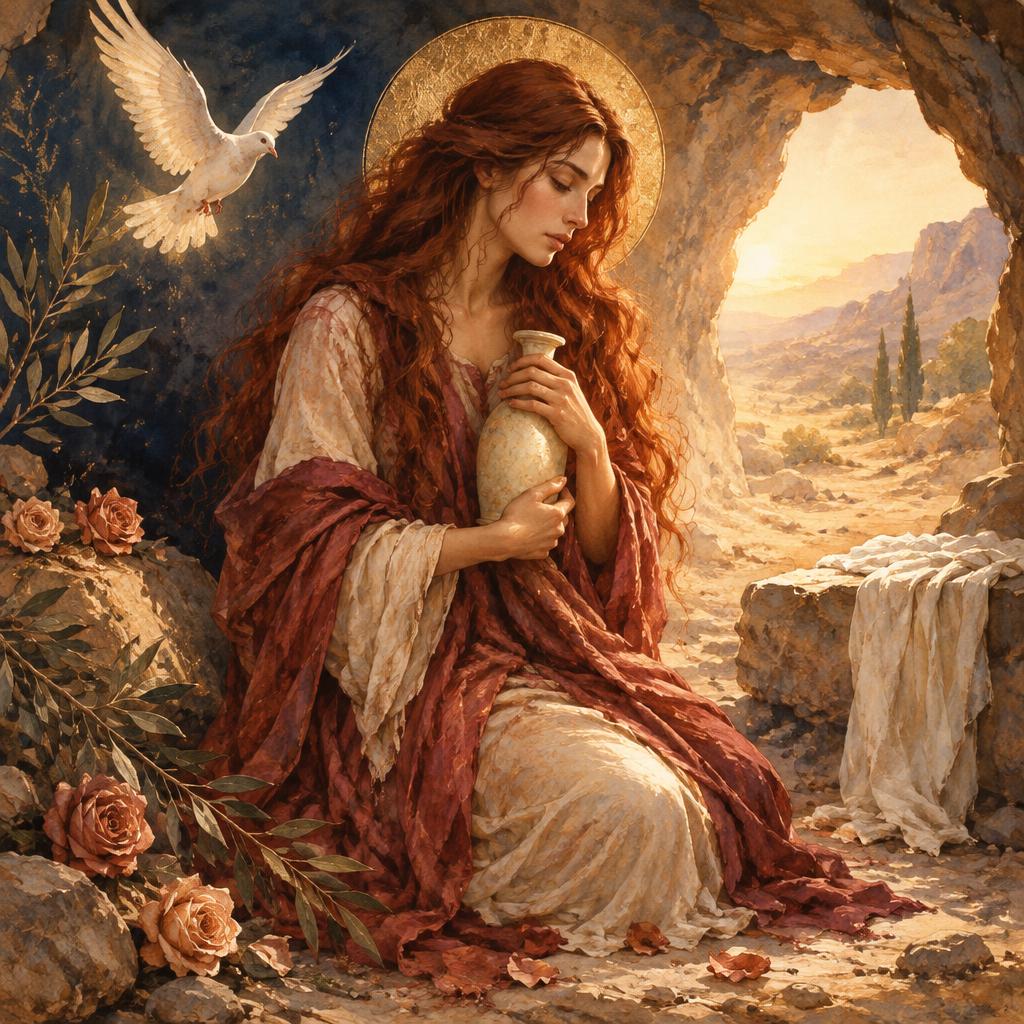
The woman history tried to erase
Mary Magdalene appears in all four gospels as a close companion of Jesus. She is named first in lists of women, first at the tomb, and first to announce the resurrection — an honor that earned her the ancient title "Apostle to the Apostles." Yet for centuries her image was reduced and distorted, her power buried under apology and invention.
"I have seen the Lord."
These were her first reported words after the resurrection. Not a theory. Not a doctrine. A direct, embodied testimony. That quality — seeing for oneself, anointing with one’s own hands, weeping and recognizing at the same time — is what makes Mary Magdalene a doorway into sacred feminine Christianity.
Anointing as a mystical act
Anointing is not decoration. In the ancient world it was medicine, consecration, burial rite, and erotic initiation all at once. Mary Magdalene’s anointing of Jesus carries all of these layers. It is an act of presence, of touch, of offering the precious thing without counting the cost.
For women and men today who are relearning the body as sacred, Mary Magdalene offers a lineage: the anointer, the witness, the one who stays at the cross while others flee, the one who returns at dawn to finish what love began.
The sacred feminine West
The reclamation of Mary Magdalene is part of a larger remembering. She stands beside the Black Madonnas, the medieval mystics, the women prophets, and the unnamed healers of the Western traditions. She is the woman who was not supposed to speak — and who spoke anyway.
"Do not weep; look, see the place where they laid him."
Her presence is an invitation to trust your own encounter with the holy, even when it contradicts the official story.
Why her image is returning now
Something in our culture is hungry for integrated feminine leadership: embodied, intuitive, sorrowful, joyful, and unafraid of death. Mary Magdalene holds all of it. She is the mystic who does not flinch.
At Boston Mystics she is honored as a guardian of the sacred feminine West — a voice for those who want spiritual depth without the rejection of the body, the senses, or the earth.
Experience Mary Magdalene in Boston
Luba Evans weaves Christian mysticism, sacred feminine practice, anointing ritual, and chant into evenings that honor Mary Magdalene’s lineage. If her story calls to you, join a Boston Mystics gathering and meet her again — not as a symbol, but as a living presence.
Nearby in the constellation
Rabia Basri
Iraq / Basra · Sufism
The saint of Basra who taught that love, not fear or hope, is the only true motive on the Sufi path.
Read